
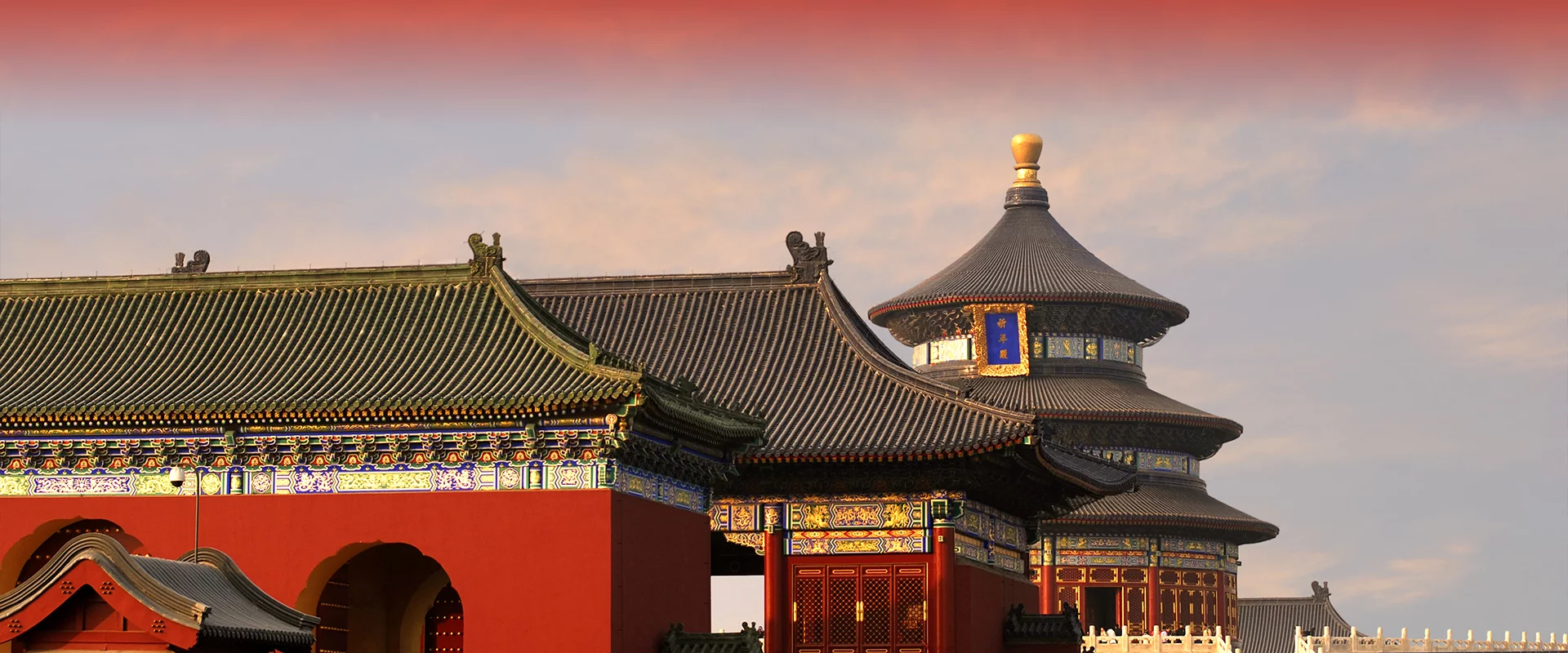
Located to the east of Zhengyang Gate, the Temple of Heaven is the world’s largest extant ancient building complex dedicated to the worship of Heaven, where emperors from the Ming and Qing Dynasties worshipped the Heaven and prayed for a bumper harvest. The northern section of the building complex is circular while the southern section square to symbolise a round sky and a square earth. With a total surface area of 2.73 square kilometres, the complex is surrounded by two walls that divides it into inner and outer sections, whereby most buildings are located in the inner section.
The inner section is further divided into northern and southern areas. Qigu Altar, with Qi’nian Hall as its central structure, in the northern area is used to pray for an abundant year in the first lunar month. Huanqiu Altar, located in the southern section with a giant circular stone platform known as huanqiu as its central structure, is dedicated to the worship of Heaven on the winter solstice. The two altars are connected by Danbi Bridge, a 360-metre-long raised path. The path in turn forms part of an axis that stretches for 1,200 metres and connects the northern and southern sections of the complex, which are flanked by ancient cypress forests.
Behind Xitian Gate and to its south is Zhaigong Palace, where emperors used to stay and fast prior to sacrificial ceremonies. In the western part of the outer section is the Sacrificial Ritual Office, which was in charge of the teaching and learning and performance of ceremonial music and dance. The main structures in the inner section include Qi’nian Hall, Huangqian Hall, Huanqiu, Huangqiong Temple, Wuliang Hall, Long Corridor, Double-Ring Wanshou Pavilion and more.
Construction of the Temple of Heaven in Beijing was completed in the eighteenth year of the reign of the Emperor Chengzu of Ming (1420) before expansion and renovation during the reigns of the Emperor Shizong of Ming and the Emperor Gaozong of Qing. It is renowned for its magnificence and majesty and its solemn and stately environment. Following the foundation of the People’s Republic of China, the state invested extensively in the protection and preservation of the ancient artefacts and relics of the Temple of Heaven. Having withstood the elements, the Temple of Heaven has become an example of ancient Eastern civilisations thanks to its profound cultural significance and grandiose architecture.
The Temple of Heaven is the culmination of the architectural skills of the Ming and Qing Dynasties and is China’s ancient architectural treasure. In 1961, China’s State Council announced the Temple of Heaven as a major historical and cultural site protected at the national level. In 1998, it was inscribed by UNESCO as a World Cultural Heritage site.